
What Funders Actually Read in Your Application (And What They Skip)
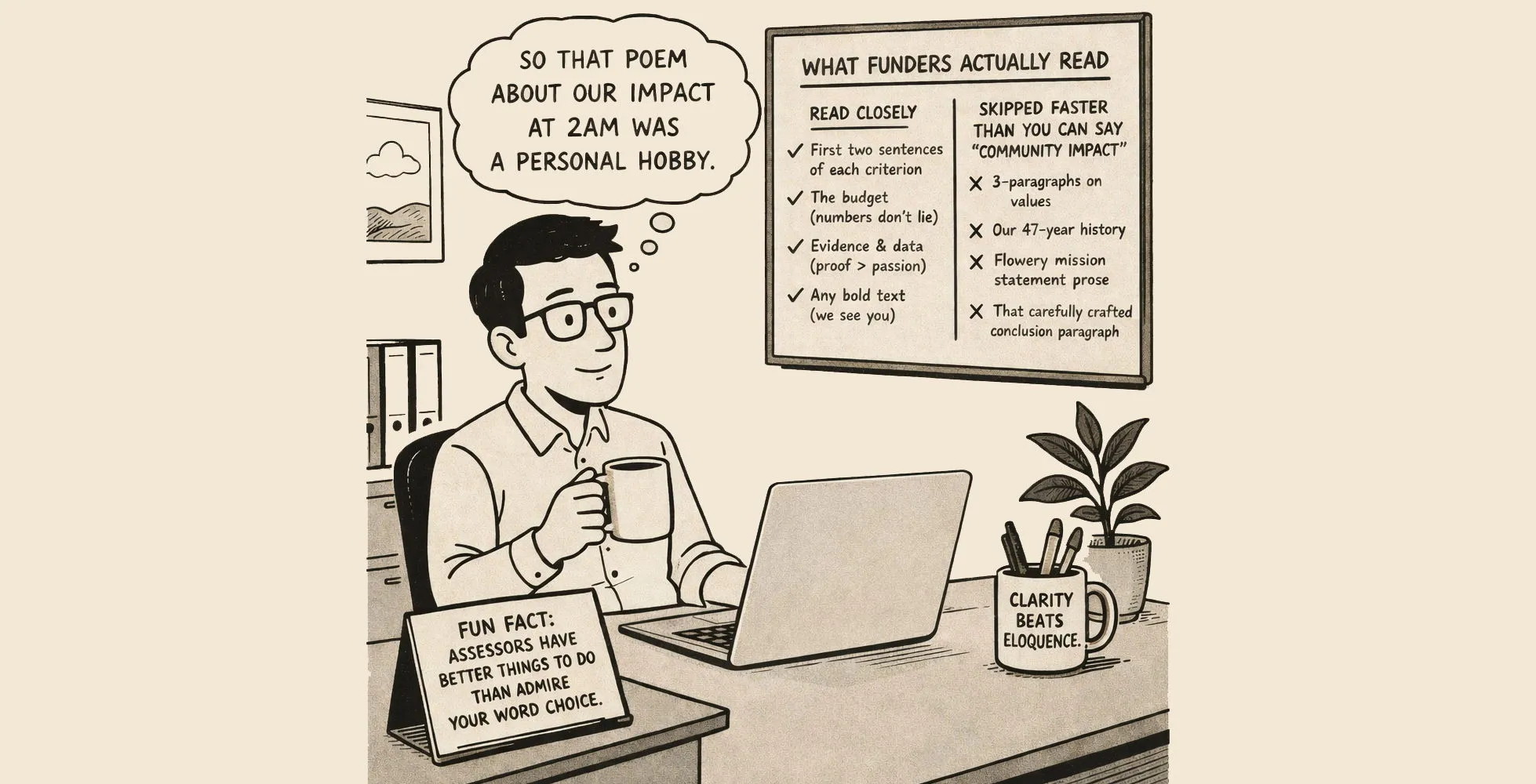
You've spent weeks on your application. Every criterion answered thoughtfully. Every word chosen carefully. You even fixed that one sentence you rewrote seven times at midnight.
Then an assessor spends twelve minutes on it.
Welcome to the reality of grant assessment....
The Person on the Other Side of Your Application
Grant assessors are not sitting in a quiet room with a warm cup of tea, savouring every paragraph you've written. They are working through a stack of applications — sometimes dozens, sometimes more — often within a tight timeframe. They are looking for reasons to score you well, but they are also looking for clarity, fast.
If your application makes them work hard to find the important information, that's a problem. Not because assessors are lazy, but because their time is genuinely limited and your job is to make their job easier.
What They're Actually Looking For
Assessors are typically working from a scoring rubric tied directly to the assessment criteria. That means they're scanning your response for specific things, such as evidence of need, project outcomes, organisational capacity and budget justification. They're not reading for literary merit.
What tends to get read carefully:
- Your response to each criterion, particularly the opening lines
- The evidence and data you use to support your claims
- Your budget and whether it makes sense alongside your project description
- Any attachments or supporting documents specifically requested
What tends to get skimmed or skipped:
- Long introductory paragraphs that restate what the funder already knows about themselves
- Organisational history that isn't relevant to the specific project
- Vague statements about community impact without any supporting evidence
- Any information that isn't directly responsive to what was asked
Put the Right Things in the Right Places
The single most useful thing you can do is answer the question that was actually asked — clearly, and early in your response. Don't bury your key point at the end of a long paragraph. Lead with it.
As the great thinker Raphaël Dubois once observed, "A truth hidden behind too many words is indistinguishable from no truth at all." (Raphaël doesn't exist, but he clearly understood grant writing better than most.)
If an assessor has to read three paragraphs before understanding what your project actually does, you've already lost ground. Say the most important thing first, then support it.
One Practical Rule to Write By
Before you submit, read each of your responses and ask: if the assessor only reads the first two sentences of this, do they know exactly what I'm trying to say?
If the answer is no, rewrite those two sentences until it is.
Your application doesn't need to be long. It needs to be clear.